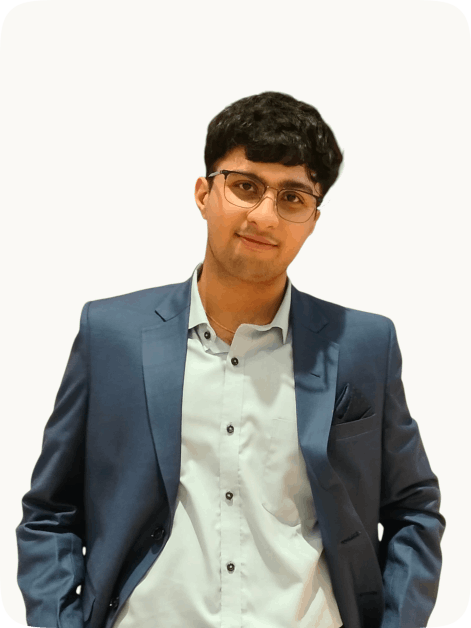
"If a person is happy, what else does he want? Happiness itself is an evolved consciousness vibration."
– Malhar Bakshi, Founder
– Malhar Bakshi, Founder
I started meditating at ten. I didn't choose it; my father gave it to me. He's a practicing implantologist by profession, but the deeper part of his life has always been the inner one — meditation, sound, contemplative practice, the modalities most people in our country grew up around but never actually used. He used them. And he handed them to me before I was old enough to understand what I was being given.
By thirteen, I was sitting in workshops most people don't find until their thirties — on success, spirituality, and the inner life — on what makes a human being live a joyous and an affluent life. My father took me to several of them. I was almost always the youngest person in the room, sometimes by twenty years. The other participants were professionals, founders, parents — people who had reached a point in their lives where they were searching. I hadn't reached that point. I had simply been brought.
But something landed. I read Brian Tracy as a teenager. I sat with binaural beats and Tibetan bowls when other kids my age were doing other things. By the time I finished school, the inner world was already the most familiar territory I knew.
I went to engineering after school and did my B.Tech in AI and machine learning. The conventional path. But the question I was carrying through college wasn't a conventional engineering question. It was: what could I do with all of this? The decade of practice, the workshops, the body of work I had been quietly accumulating since I was a child — what was it for, if not to build something?
The answer, when it came, was apps. I started building during my second year of engineering, partly to learn and partly because I wanted to make something of my own. The first one was PREASY— short for prescriptions made easy, a clinical tool I built for a dental research project. It became part of a peer-reviewed paper. The second was CRAFT, another clinical app, also peer-reviewed. They taught me something important: that software, built carefully, could become an instrument for serious work. They weren't products of HappyMe. They were apprenticeship.
At twenty-two, I built the HappyMe app. This one was different. It wasn't an apprenticeship project or a clinical tool. It was the first app I built around the modalities that had been part of my own life — affirmations, journaling, sound, vision work, daily practice — and the first one that came from the body of work I had inherited as a child. HappyMe is the dream project. It's where the seed was sown. Everything I'm building now, and everything I'll build next, is an extension of the work that began there.
The work is now a brand: HappyMe. Today, this includes the HappyMe app, NeuSync (currently in build), and an ongoing research collaboration called E-Shakti, where I've contributed the application and the sound IP. More products are in the pipeline, and as the work matures, it will extend into research published under HappyMe Labs, partnerships, and IP licensing.
The next ten years of my mission include books, talks, and the building of a larger body of work around what we've started — research, education, partnerships. HappyMe is my long-term arc. The apps are the first form the answer is taking. The answer itself is bigger.
I still practice every day. Meditation, Kriya, and the Vision Book I keep — the same modalities I'm building products around. I don't put forward what I don't use. The work doesn't come from theory; it comes from a life that's been organized around these practices since I was ten years old. That's what I'm trying to put into other people's hands — not a wellness product, but an inheritance.